
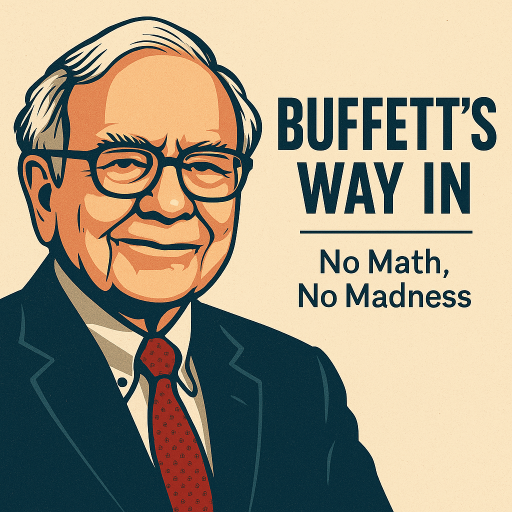
Investing 101: No Madness, No Math
The timeless investing mindset that beats trends, hype, and hedge funds.
Investing can feel intimidating. You might see headlines about complex fintech trends, crypto, or day-trading apps and feel late to the party. Yes, investing is a complicated game but it does have simple solutions. You can play it the Warren Buffett way and you will not need advanced math, constant market-watching, or a finance degree. Warren Buffett said,
“If calculus or algebra were required to be a great investor, I’d have to go back to delivering newspapers.”
The legendary investor offers simple, timeless advice that anyone can follow. Buffett’s commonsense approach has long been a safe harbor amid the market madness, proving itself through decades of market ups and downs. And as Buffett himself notes, even with all the new technology and trends, “the fundamentals of investing have not changed over time”.
Investing The Warren Buffett Way
You do not need to read long books, watch courses or buy finance textbooks. In this article, we’ll explore Warren Buffett’s investing philosophy tailored to people new to the stock market.
Buffett—often called the “Oracle of Omaha” and regarded as one of the most successful investors ever—has a knack for explaining investing in clear, no-nonsense terms. His guidance focuses on timeless truths like patience, emotional discipline, and the power of compounding, rather than hot tips or complicated strategies. He believes investing should be kept simple and low-cost, and he’s even structured his own family’s finances around these principles.
By the end of this article, you’ll see that you can be a confident investor without needing to beat Wall Street at its own game. Let’s dive into Buffett’s top tips for beginners.
Lesson #1: Choose Index Funds Over Stock Picks
One of Buffett’s most famous pieces of advice is also his simplest: most people should invest in low-cost index funds rather than trying to pick individual stocks.
An index fund is a pre-packaged basket of many stocks (for example, an S&P 500 index fund contains shares of the 500 largest public U.S. companies).
Instead of obsessing over which stock to buy, you can buy the whole basket and follow the market’s long-term trend. Buffett believes this approach consistently beats the results of most amateur and professional stock pickers.

Disclaimer: The information provided in this article, including the images, is for educational and informational purposes only and should not be construed as financial or investment advice. Past performance is not indicative of future results. Always do your own research or consult with a licensed financial advisor before making investment decisions.
Leading By Example
Buffett doesn’t just say this—he lives by it. Perhaps the most striking example is his advice for his wife’s inheritance. In his will, Buffett instructs that after his death, the money for his wife should be invested 90% in a low-cost S&P 500 index fund and 10% in government bonds.
He explained that this simple 90/10 portfolio will ensure she’s taken care of. Why? Because it’s low-cost, automatically diversified across hundreds of strong companies, and easy to maintain.
“She’ll do fine with that. And anybody will do fine with that. It’s low-cost, it’s in a bunch of wonderful businesses, and it takes care of itself,” Buffett said.
Hands-Free Investing
The phrase “takes care of itself” is important. As a busy person, we all seem busy these days, you might worry you don’t have time to babysit your investments daily. With an index fund strategy, you don’t have to. You’re not required to constantly buy, sell, or follow market news 24/7.
Buffett’s plan for his wife (and for the “average person who is not an expert on stocks”) is essentially a set-it-and-forget-it approach. You make regular contributions to a broad index fund, and then leave it alone to grow over time. No fancy maneuvers or daily tinkering are required.
Warren Buffett is a supporter of the U.S. stock market. He believes it will outperform all other markets, and there is no point investing your money elsewhere. I am not sure I share his view today but who am I to question his decades of investment success?
The timeless advice here is passive index funds. Whether the index tracks the U.S. stock market or not, you can decide for yourself.
The $1 Million Bet Against Hedge Funds
To prove his strong conviction in index funds, Warren Buffett made a $1 million bet. In 2008, he wagered that over 10 years, a plain S&P 500 index fund would outperform a selection of hedge funds (high-fee investment funds run by experts). A decade later, Buffett won the bet by a landslide – the index fund gained about 7% per year (despite the 2008 crash), while the hand-picked hedge funds returned only about 2% per year. The supposed Wall Street wizards, with all their trading, couldn’t beat the simple index once their hefty fees were subtracted.
Buffett’s takeaway is: don’t waste money on expensive funds or hot-shot stock gurus. Save on fees by sticking with a low-cost index fund, and you’ll likely outperform most fancy strategies in the long run. He even joked that investors should erect a statue of Jack Bogle, the founder of Vanguard and pioneer of index funds, for helping ordinary people invest effectively at low cost.
You might not get the excitement of picking the next hot stock, but you’ll get something better: a virtually hands-free investment that historically grows with the economy.
Lesson #2: Invest Like You’ll Hold Forever
If there’s one word that comes up again and again in Buffett’s investing philosophy, it’s “long-term.” He often says his favorite holding period for a stock is “forever”. While you don’t have to hold an investment forever, the spirit of that advice is to choose well and let time and compounding do the heavy lifting.
Unlike the frantic trading some folks do, Buffett’s style is buy-and-hold. He likens investing to planting a tree:
“Someone’s sitting in the shade today because someone planted a tree a long time ago.”

That quote is a beautiful reminder that the money you invest now can grow into something big in the future, but you have to give it time to grow. The same quote can be applied to starting a business, developing relationships, or learning new skills.
Lessons From His Childhood
Buffett started investing as a child and has seen the power of compounding over decades.
Perhaps the best illustration of patience paying off comes from a personal story Buffett loves to share: his first-ever stock investment. In 1942, when Buffett was 11 years old, he saved up $120 and bought his first stock together with his older sister.
Almost immediately, the stock dropped by a lot – from about $38 down to $27 – and a young Buffett panicked. His sister “reminded” him daily that they were losing money. As soon as the price inched back up and they could grab a small profit (a mere $5 per share), Buffett sold the stock to stop their nerves from jangling. He was relieved to have made any profit at all.
But guess what? Shortly after he sold, that same stock soared to $202 per share. In hindsight, if he had just held on longer, the profits would have been dramatically larger.
Buffett calls this one of the most important learning experiences of his life. In fact, he says it taught him three key lessons about investing, which he’s never forgotten:
| Don’t overly fixate on what you paid for a stock | Don’t anchor your thinking to your purchase price – focus on what the investment is worth now and in the future. |
| Don’t rush to sell just because you have a small profit | Be patient; the best gains often come with time. Selling too early can mean leaving major money on the table. |
| Don’t invest someone else’s money or money you can’t afford to lose | Buffett felt extra pressure because his sister’s money was involved. This taught him never to gamble with funds that aren’t appropriate for risk. |
Bonus Lesson For Our Children
80 years later, my son is now 10 but he has not purchased his first stock yet. He could have had a portfolio of stocks already, sorry, I mean a portfolio of index funds. A few months ago, he wanted to buy Nike shares. He is 10, and he loves the brand. However, I did not support him because I did not think it was a good long-term investment.
Now I think I should have encouraged him instead. We often do not take action because we do not see how we can gain big from it but sometimes gaining small or not gaining at all is much more valuable than doing nothing.
Lessons From His Company
Buffett’s own company, Berkshire Hathaway, is a testament to long-term thinking. He’s held some stocks for decades (he first bought Coca-Cola in 1988 and still holds it today, for example).
“Our favorite holding period is forever,” Buffett wrote in a 1988 letter, urging investors to not “cut the flowers and water the weeds.”
Graph. Berkshire Hathaway Inc. (BRK) Share Price Return vs. S&P 500 Index Return Last 20 Years

Source: Yahoo Finance https://finance.yahoo.com/quote/BRK-A/
Too often, people sell their good investments too early (cutting the flowers) and hang on to bad investments hoping they’ll come back (watering the weeds). Buffett does the opposite: he hangs on to quality businesses and lets them bloom over many years. By adopting this patient approach, you allow compounding returns to build wealth for you. It’s not flashy or quick, but it’s extremely powerful.
Don’t Leave Your Circle of Competence
You might be thinking – what I just bought, how do I know it is a Coca-Cola stock and not a Kodak one (Kodak is a notable example of a large public company that filed for bankruptcy in 2012)?
With index funds, you do not have to do stock-picking. You can do macro bets on countries, groups of countries, or even sectors. If you decide to do stock picking, stick to industries that you know very well. If you work for a pharmaceutical company, for example, you are in a better position than me to forecast which firm will do well in the future. I work for an investment bank, and I have banking stocks in my portfolio (next to index funds, of course).
Warren Buffett famously says he won’t invest in a business unless he can understand how it actually makes money. For years, he avoided tech stocks because he didn’t feel comfortable predicting their futures – proving that even geniuses stay within their circle of competence.
The power lies in knowing one’s own limitations, keeping your ego in check, and sticking to what you are comfortable with. He is sometimes criticized for that but he should be respected for it instead. He has a philosophy and he follows it. Does his philosophy work? Yes. Could he have made more money with something else? Maybe yes. Does it matter? No.
Lesson #3: It’s Not About IQ. It’s About Character
A big mental barrier that holds many people back (especially highly educated, successful ones who are used to excelling) is the fear that “I don’t know enough about finance to invest” or “I might not be good at this.” If you’ve ever felt that way, take heart: Warren Buffett insists that investing is not about IQ or fancy math skills. The truth is, the math required for basic investing—like calculating percentages or compound growth—is stuff most of us learned by middle school. You don’t need to be able to price complex derivatives or predict interest rates to be successful.
What does matter, according to Buffett, is having the right temperament and basic good habits.
“Success in investing doesn’t correlate with I.Q. once you’re above the level of 125. Once you have ordinary intelligence, what you need is the temperament to control the urges that get other people into trouble in investing.”
Buffett has said in various ways over the years. By “temperament,” he means qualities like patience, discipline, and rationality. Essentially, can you keep your cool when others are losing theirs? Can you stick to a sensible plan without getting swept up in euphoria or despair? These emotional strengths are far more important than being able to do multivariable calculus or recite macroeconomic theory.
When you think about it, isn’t temperament important for everything we do in life? Investing is a way to test yours and learn, evolve, and grow in character.
Don’t Sway From Fear or Fads
Even with a simple plan in place, our own emotions can be the biggest obstacle to investing success. The stock market has a way of testing your nerves. Prices will plunge during recessions and soar during euphoric booms. The media will alternately scream that the world is ending or that you must buy this hot stock now. It’s easy to get caught up in either fear or greed, the two emotions that most often derail investors.
So what does emotional discipline look like in practice? Buffett summed it up in a famous rule:
“Be fearful when others are greedy, and greedy when others are fearful.”
This doesn’t mean you literally need to be greedy; it means don’t follow the crowd. When everyone else is throwing caution to the wind (say, during a hype-driven bubble in tech stocks or crypto), that’s when you should be extra cautious (fearful about overpaying). And when everyone is panicking and selling in a crash, that’s when you should keep calm and perhaps look for buying opportunities (being “greedy” in the sense of recognizing bargains).
This contrarian mindset is tough – it feels much more comfortable to do what everyone else is doing. But Buffett credits much of his success to avoiding herd mentality. He doesn’t get swept up in mania, nor does he flee in terror during downturns. In fact, Buffett often welcomes market declines as a chance to buy great companies on sale, much like you’d welcome a clearance sale in your favorite store.
Investing Is Not Gambling
Buffett likes to remind shareholders that the stock market can behave like a “casino” in the short term, with people making reckless bets. Today, with zero-commission trading apps on our phones, it’s easier than ever to treat investing like gambling. Buffett warns that
“the casino now resides in many homes and daily tempts the occupants”.
But you don’t have to play that game. You’re not in the stock market to roll the dice; you’re in it to steadily build wealth. So when you see others bragging about day trading or a meme stock skyrocketing, take it with a grain of salt. Many fortunes have been lost by jumping into speculative frenzies. Buffett’s steadiness is an alternative to this.
“Only buy something that you’d be perfectly happy to hold if the market shut down for 10 years,” Buffett shares.
If you adopt that mindset, you’ll naturally filter out a lot of bad, short-term behavior.
You don’t have to hit home runs; just avoid disastrous mistakes. In Buffett’s words,
“You only have to do a very few things right in your life so long as you don’t do too many things wrong.”
From 0 To Investor: Anyone Can Do This
Warren Buffett’s investing style is easy to summarize—keep it simple, think long-term, control your emotions, and avoid needless costs. It appeals to new investors because it doesn’t require you to transform into a stock-picking guru or devote every waking hour to finance. You can invest effectively on your own terms, even with limited time and money. Buffett’s approach assures you that investing is not rocket science. It’s about consistently doing a few sensible things and not getting derailed by panic or hype.
These few sensible things according to Warren Buffett are:
- low-cost index fund strategy
- long-term mindset
- calmness and discipline
Buffett’s decades of success prove that slow and steady can indeed win the game. He has built an immense fortune not by quick trades or secret algorithms, but by buying great businesses (or index funds of businesses), and holding on through thick and thin.
If you ask Buffett when is a good time to start investing. He might reply with one of his favorite proverbs
“The best time to plant a tree was 20 years ago. The second best time is now”.
✦ Hi, I’m Mariya Boychinova— founder of SmartyPurse, where I teach people how to be happy, rich, and free by applying real finance principles to everyday life. I’ve spent 15 years in investment banking, wealth management, and fintech, and now I share what truly works to build wealth and freedom.
For more motivation to start your investing journey, read this article:
If you want to learn about investments risk and return, check out Money Truth #1 here: 3-money-truths-to-fast-track-your-financial-success
To hear more about Warren Buffett and his investing philosophy, I enjoyed the movie “Becoming Warren Buffett” featured on YouTube here:
Disclaimer: The information provided on SmartyPurse.com and in this article is for educational and informational purposes only. It is not intended as financial or investment advice and should not be construed as such. Always consult with a licensed financial advisor or investment professional before making any investment decisions. Past performance is not indicative of future results. Investing involves risk, including the risk of loss.